
Seeding and establishment
Watering New Grass Seed: Adjust as Roots Develop
Keep new grass seed moist, then adjust watering as seedlings develop. Check rainfall, mixtures and coverage with an observation sheet.
By Seed & Mow · 7 min read · Sources checked
Water new grass seed often enough to keep the seedbed moist without leaving it saturated. As the seedlings establish, gradually water less often and more deeply. The right change depends on the grass, its development, rainfall and your soil, rather than a nationwide “day 14” schedule.
Use the observations below to decide what to check before the next watering. This guide focuses on actively germinating seeded lawns, especially cool-season grass. Sod, plugs and dormant seeding need different aftercare. Your local extension guidance and any watering restrictions still apply.
Start with the seed and the site
Keep the seed label and record the planting date, lawn area and species in the mixture. Mark sunny edges, shaded sections, slopes and low spots separately. One timer program can hide very different conditions within the same yard.
Kansas State's establishment guide explains that germination speed varies with species and growing conditions. Its ideal-condition ranges are shorter for perennial ryegrass than for Kentucky bluegrass. Those ranges explain why a mixture can emerge unevenly; they are not a deadline for your lawn.
For future planting, correct persistent site problems first. A soil test can inform nutrient and pH decisions, but it does not diagnose sprinkler coverage or fix a low spot that collects water.
Before and during germination: protect the seedbed
New seedlings are vulnerable to drying. Apply water gently enough to avoid moving seed or washing soil downhill. Aim for a moist seedbed, without puddles or water leaving the area.
UC IPM's California guidance distinguishes preparing the soil before planting from watering after seed is down. Its deep preplant watering recommendation is not an instruction to soak freshly sown seed repeatedly. After planting, it calls for light, frequent irrigation and warns against both drying and excessive water.
Check several representative places rather than judging only the grass beside the sprinkler. A dry-looking surface or a dark color alone is an incomplete test: examine the actual moisture near seed depth at an accessible edge without repeatedly disturbing seedlings. Record whether it is drying, moist or saturated. This is a practical observation aid, not a calibrated moisture measurement.
First sprouts: do not rush the whole mixture
Green shoots do not prove that every component of a seed mixture has emerged. Minnesota Extension's renovation guide says to maintain moisture until all varieties in the mixture have germinated. It specifically notes the slower emergence of Kentucky bluegrass.
You cannot confirm every individual seed from above. Use the label, expected development under local conditions and observations across the area. If emergence is uneven, check coverage and moisture before deciding the thin area simply needs a longer whole-zone soak. Ask a local extension adviser if the stage or cause remains uncertain.
When overseeding, distinguish the established grass from the young plants underneath. A green canopy can make a newly seeded gap easy to overlook. Keep an observation for the gap itself rather than using the older lawn as the only indicator.
As seedlings establish: ease into deeper watering
The direction of change is consistent across extension guidance: lengthen the interval gradually while allowing water to reach farther into the developing root zone. Do not deliberately wilt young plants to “train” roots, or switch abruptly from frequent watering to a mature-lawn schedule.
Purdue and Illinois' establishment guide uses seedlings about 2 inches tall as a cue to begin reducing frequency and watering more deeply. It describes deeper, less frequent irrigation after two or three mowings. These are development markers in a regional guide, not proof that every seeded patch is ready at the same moment.
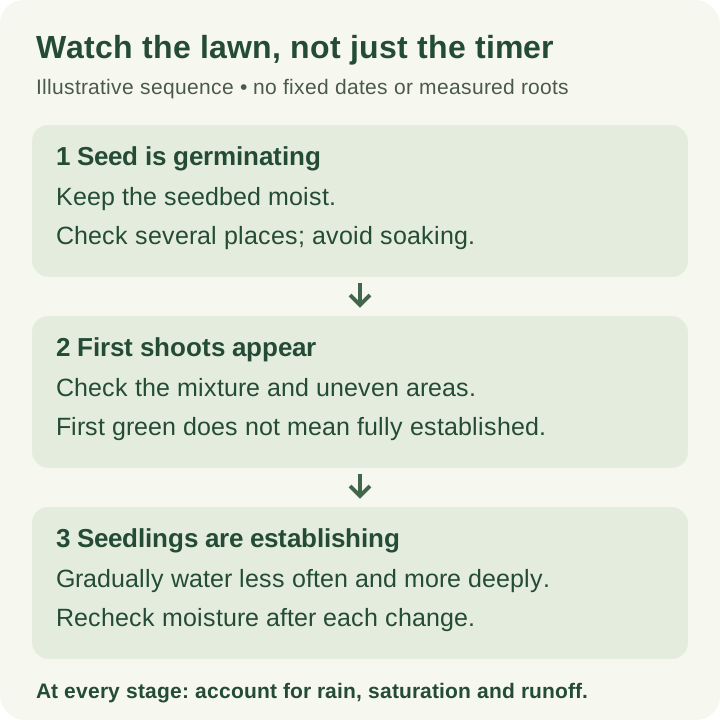
After a change, recheck the seedlings and soil before extending the interval again. Longer watering must still stop short of saturation or runoff. The original illustration below summarizes the observation sequence; it does not show measured roots or certify readiness.
Why the published schedules differ
Regional numbers are useful context, but combining them into one average creates a rule none of the sources actually recommends.
- Iowa State's newly seeded lawn FAQ describes light applications through an initial three-week period and a gradual change as seedlings reach 1–2 inches. Hot or windy conditions can require more attention.
- UC IPM allows for several light waterings a day for up to 30 days, with adjustments as seedlings establish. Its California examples are not an automatic 30-day timer setting everywhere.
- NC State's tall-fescue calendar advises keeping the seedbed moist during regional fall renovation in North Carolina. It does not supply a universal seedling transition date.
Use the guidance for your grass and region, then check whether the lawn is developing as expected. If those clues disagree, investigate rather than averaging the calendars.
Rain, uneven coverage and runoff change the decision
Rain is part of the water supply. Minnesota's seeding guide explicitly calls for minimizing irrigation during rain. Check what reached the seeded area before running the next scheduled cycle; a forecast is not the same as rain already received.
For uneven watering, inspect sprinkler direction, obstructions and leaks. Minnesota's irrigation-audit guide explains how catch containers reveal differences in application. Ideally check the equipment before seeding. Its full audit run time is a measurement procedure, not a recommended watering duration for a tender seedbed.
If water ponds or carries seed away, stop that application. Reassess the amount, delivery and site drainage before repeating it. Adding minutes to rescue a dry edge can worsen an already-wet low spot. Persistent ponding or erosion warrants local help; this checklist cannot design a drainage repair.
Worked example: a dry edge and a wet corner
This is a fictional observation example, not a field trial or a customer result.
A homeowner has seeded one front-lawn zone with a cool-season mixture. First shoots are visible. At the next inspection:
- The sunny edge is drying near the seedbed.
- The center is moist.
- The low corner has standing water after rain.
They avoid adding time to the whole zone. Before the next automatic cycle, they check the wet corner and coverage, gently water the drying edge as needed, and reduce or skip whole-zone irrigation while rain is keeping the other areas moist. They record where shoots have appeared and keep checking the slower areas. They seek advice if water continues to collect.
The useful result is a better next observation, not a promise that one adjustment will establish the entire lawn. Use a separate worksheet for areas that behave differently.
Keep a short watering record
For each area, write down:
- Date, time, seed mixture and current stage
- Rain actually observed and any irrigation applied
- Moisture at several representative spots
- Uneven emergence, puddles, runoff or delivery problems
- What changed and what you will check next
The printable sheet below works without an account or email address. For a longer record, the lawn log guide shows how to keep observations distinct from actions and results. Avoid recording a watering adjustment as a success before checking what happened afterward.
Connect watering with the next mowing decision
Watering progress and mowing readiness are related, but they are not the same test. Check seedling height, existing turf and ground conditions separately. Our first-mow guide walks through those observations without setting one national waiting period.
Once the lawn is established, reassess the irrigation program for the grass, soil and season. Frequent seedbed watering should not become a permanent routine. This guide does not prescribe an established-lawn weekly amount or promise a specific sprinkler run time.
If you are still deciding which fescue to plant, the fine-fescue versus tall-fescue comparison helps separate grass selection from aftercare. Keep the seedbed checks in a lawn-care log so rainfall, irrigation and root observations stay together.
Build on these observations with another practical lawn-care guide. Continue with How to Keep a Lawn Treatment Log You Can Actually Use.
Keep a useful watering record
Record the seedbed, rainfall and watering observations together. Use the lawn-care log guide to make the next check easier to compare.
Keep a lawn-care log