
Grass selection
Fine Fescue vs Tall Fescue: Which Fits Your Lawn?
Compare fine and tall fescues using your region, shade, drainage and lawn use. Includes species differences and a two-zone observation worksheet.
By Seed & Mow · 8 min read · Sources checked
Fine fescues are worth considering for a fine-textured, lower-input lawn where local climate, shade and use suit them. Where locally adapted, turf-type tall fescue is often a better candidate when a cool-season lawn needs to tolerate more wear and summer heat. The useful choice depends on the actual area you are planting, not just the word “fescue” on the bag.
Start with your region, then compare light, drainage, foot traffic and the amount of care you want to give. This guide helps you make that shortlist. It cannot identify every grass from a distant lawn photo or select a cultivar for every climate.
First, check which fescue you mean
Fine fescue is a group of narrow-leaved grasses. Turf-type tall fescue is a different grass, even when a seed bag describes its leaves as fine. University of Georgia Extension specifically warns about this naming confusion. Newer tall-fescue cultivars can have a finer texture than older types without becoming fine fescues.
The five commonly discussed fine fescues are strong creeping red, slender creeping red, Chewings, hard and sheep fescue. They share a fine texture, but their growth habits differ: the two creeping red fescues form underground stems called rhizomes; Chewings, hard and sheep are primarily bunch-forming. Purdue's fine-fescue guide explains these differences.
Tall fescue grows mainly from clumps. Short rhizomes can occur, but it has limited ability to fill empty ground. Rutgers' tall-fescue guide separates surviving a traffic event from replacing plants whose crowns were destroyed. For a bare patch, see what tall fescue can and cannot repair.
Compare the site before comparing seed bags
Use these as starting questions rather than a universal ranking.
- Texture: Fine fescues have very narrow leaves. Turf-type tall fescue is generally broader, with substantial cultivar variation.
- Shade: Fine fescues deserve a place on the shortlist in suitable cool-climate shade. Tall fescue can also suit partial shade. Neither name promises a good lawn beneath a dense canopy.
- Use: A lawn crossed occasionally and a daily running route need different evaluation. Look at the particular fine-fescue species, the cultivar and the site's stress conditions.
- Water and soil: Drought tolerance depends on establishment and rooting. Persistently wet ground needs investigation before either choice.
- Upkeep: Decide whether you want a regularly mown lawn or a deliberately taller, reduced-mow area. Those are different management goals.
For tall fescue, UC IPM's California guide describes sunny or partly shaded use, moderate traffic tolerance and newer turf-type textures. Treat those as California guidance, not a promise of the same result everywhere.
Shade is more than hours on a seed label
Look at the area during the growing season, including when nearby trees are in leaf. Note whether shade comes from a building or a tree, whether the soil stays wet, and where people walk. A single observation at noon misses much of the picture.
NC State's shade guide explains that tree-root competition, limited light and prolonged leaf wetness can all weaken turf. Shade also reduces its ability to withstand use. In very heavy shade, a suitable non-turf planting or mulched area may be more practical than repeated reseeding.
Do not prune roots or reshape a mature tree just to fit a grass choice. First ask a local extension adviser or qualified arborist whether a change is appropriate for that site.
Traffic tolerance varies within the fine-fescue group
A simple “fine fescue is weak, tall fescue is tough” comparison misses useful detail. Minnesota Extension's fine-fescue guide rates wear tolerance differently among fine fescues: Chewings and slender creeping red score better than strong creeping red and sheep fescue in its comparison, with hard fescue between those groups. Those are relative ratings, not permission for unlimited play.
Also separate wear tolerance from repair. A grass may resist some damage yet recover poorly once living plants are lost. Tall fescue's limited lateral spread makes that distinction important. Repeatedly worn routes deserve a plan for the use of the space, not just a tougher-sounding seed name.
Drought resistance needs roots and realistic expectations
Both groups include useful drought-tolerant lawn options. That does not mean a new seeding can be left to establish without care, or that an established lawn will remain green through every dry spell.
Rutgers notes that tall fescue on shallow or unhealthy soil has a restricted root system and less persistence during severe drought. It also recommends withholding traffic while tall fescue is dormant during drought. Its source is about New Jersey sports turf; the rooting limitation is relevant here, while its field-use schedules and application rates are not a home-lawn prescription.
For an existing lawn, record rain, soil moisture and sprinkler coverage before changing the watering program. The measured sprinkler-runtime guide explains how to work from what your equipment actually applies. It is separate from new-seed aftercare.
Your region can change the answer
A recommendation that works in one state can fail in another part of the country.
Purdue recommends fine fescues in sun through shade in northern Indiana, but limits their southern Indiana use to moderately dense shade because of greater summer stress. In sunny southern Indiana sites, it identifies tall fescue as a possible better option. That is a regional comparison, not a national temperature cutoff.
In Georgia, the university's selection guide reports that fine fescues generally perform less well than tall fescue. Farther north, Minnesota's seed-selection guide raises a different concern: avoid tall fescue where winter ice accumulates, and, for Minnesota, spring seedings have better first-winter survival.
Bring your county or broad region to the decision. A hardiness zone alone leaves out summer conditions, drainage and how the lawn is used.
Lower maintenance still needs a plan
Fine fescue can support a reduced-input lawn, but “no-mow” does not mean no care. Minnesota Extension notes that reduced-mow lawns commonly still need occasional mowing. A regularly maintained fine-fescue lawn should be mown according to growth, and traffic or mowing during drought stress can damage it.
Choose a locally appropriate cutting height and watch actual growth instead of promising one mowing interval for the whole year. The grass-type mowing guide explains the observation habit. Check nutrient needs with appropriate local guidance and soil-test information; the grass name alone is not a fertilizer order.
Worked example: one yard, two different decisions
This is a fictional planning example, not a customer result or a tested seed recommendation.
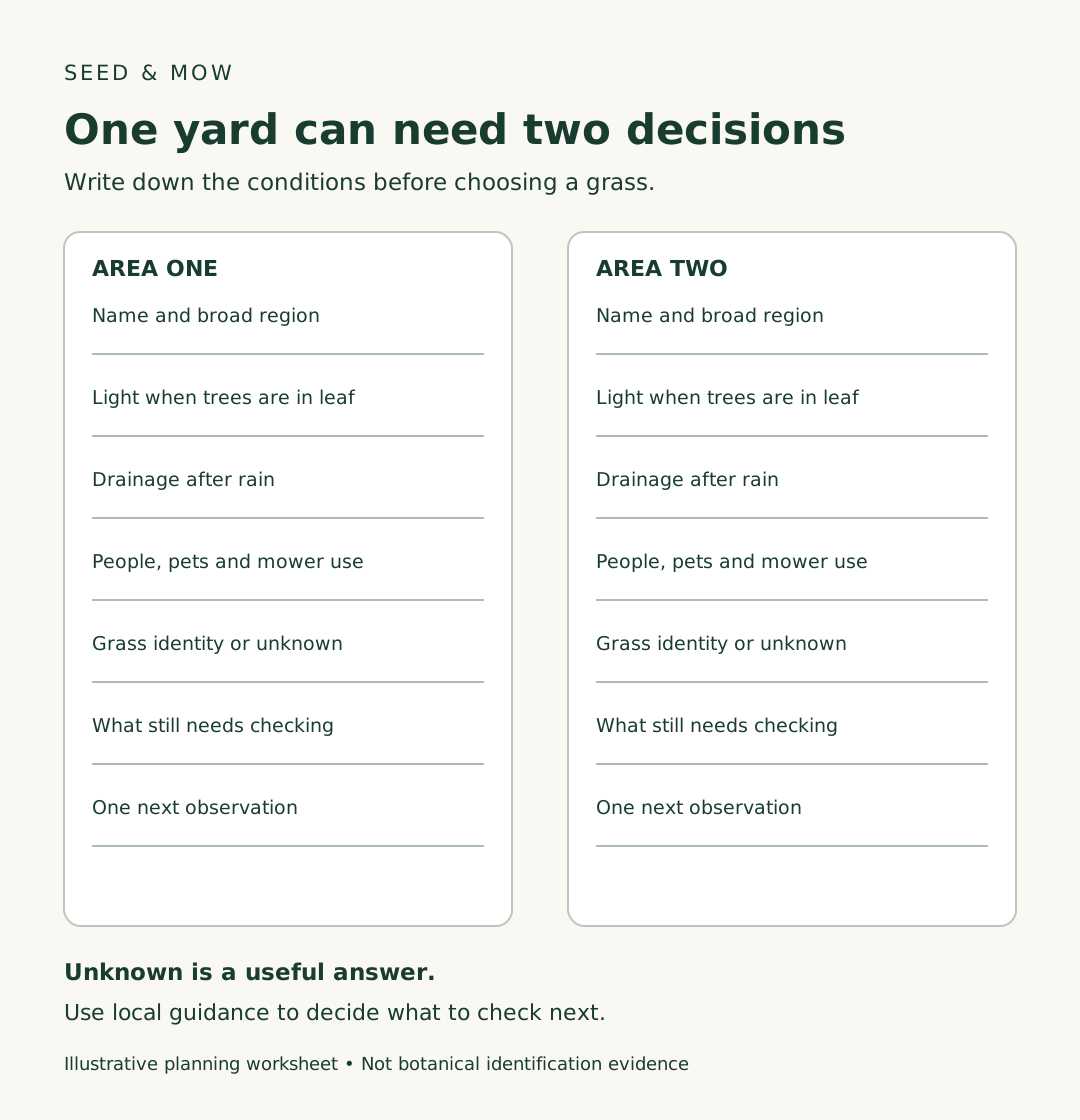
A homeowner in a cool-climate area has a sunny back play area and a lightly used side strip beneath trees. The side strip looks thin. Before buying one mixture for both spaces, they make two records:
- Back play area: frequent use; sunny; grass identity uncertain; soil condition still to check.
- Side strip: intermittent tree shade; little use; wetness after rain unknown; repeated thinning.
The next step is to observe the missing conditions and check locally suitable grasses. A fine-fescue mixture may deserve consideration for the side strip if drainage and light permit it. A locally adapted turf-type tall-fescue option may deserve comparison for the play area. Neither is selected until the site questions are answered.
The two-zone worksheet below keeps space for unknowns. Leaving a fact blank is more useful than disguising a guess as a recommendation.
What to check before you buy
Read the seed label for species and cultivar names, the test date, germination and unwanted material. Minnesota's seed guide explains that a blend combines cultivars of one species, while a mixture contains more than one species. Marketing names do not replace that information.
Compare local cultivar evaluations and save a picture of the label with your lawn notes. Avoid assuming that seed percentages by weight describe the exact share of the finished lawn; species, establishment and care affect the eventual stand. Rutgers illustrates that seed sizes alone can make seed counts differ greatly from bag percentages.
If your existing grass is uncertain, document an intact leaf, the base where it joins the shoot, and any runners, along with an overview. Keep the result as unknown if those details are insufficient. Adding a second grass before confirming the first can make future maintenance choices harder.
Common questions
Is fine-bladed tall fescue a fine fescue?
No. “Fine-bladed” describes texture. Check the species and cultivar on the seed label; improved tall fescue remains tall fescue.
Can I mix fine fescue and tall fescue?
They can appear together in locally recommended mixtures, including examples in NC State's shade guidance. That does not establish one ideal ratio for every lawn. Check local adaptation, appearance and maintenance goals before selecting a mixture.
Which one fills bare spots faster?
The answer depends on the actual species. Creeping red fine fescues have rhizomes; several other fine fescues and tall fescue are mainly bunch-forming. Identify the grass and the reason for the gap before deciding whether to wait or repair it.
Make your shortlist useful
Name the lawn area, record the conditions you know and choose the next missing fact to check. If the grass is uncertain, explore the grass identification guide and compare the visible features. Keep the identification open when clues are missing, and use local advice for seed selection.
Build on these observations with another practical lawn-care guide. Continue with How to Mow Your Lawn for the Grass You Actually Have.
Take a closer look at your grass
Compare leaf and growth clues before choosing a name. Confirm the species and ask local extension about cultivars that fit your site.
Explore grass identification