
Watering
How Long Should You Run Your Sprinkler? Measure First
Find sprinkler runtime from a measured application rate and a water amount chosen for your lawn. Then check rainfall, soil moisture, coverage, and runoff.
By Seed & Mow · 6 min read · Sources checked
To find how long to run your sprinkler, you need two things: an irrigation amount chosen for your lawn's current needs, and a measured sprinkler application rate. Minutes alone cannot tell you how much water lands on the grass.
The calculation is: target inches divided by measured inches per hour, multiplied by 60. Colorado State University Extension explains this conversion.
This guide is for established lawns. Newly seeded, overseeded, or freshly sodded areas need their own establishment guidance. Keep those areas separate when planning irrigation. For mowing newly seeded cool-season grass, use the separate first-mow guide.
Choose the water amount before the minutes
Start with your local extension service's advice for your grass and soil, and your water provider's current watering rules. Ask whether a recommended amount is per watering or a total for the week, and whether it includes rainfall. Record the answer with its units.
Grass type, rooting depth, weather, shade, and soil affect the amount and frequency. Sandy soil holds less available water than finer-textured soil; clay-rich or compacted ground may absorb water slowly. Colorado State's lawn-care guidance explains why these conditions change the plan.
Check moisture below the surface in representative spots. The aim is to moisten the active root zone when needed; water that drains beyond it is wasted. An inch of collected water is an application depth, not a promise that the soil became wet exactly one inch down. Check the soil afterward to see what actually happened.
Measure your sprinkler with a catch-can test
Use matching, straight-sided, flat-bottomed containers and a ruler, or suitable irrigation catch cups. Choose a calm, rain-free period when the lawn needs water and watering is permitted. The sprinkler test also waters the lawn; include it in today's total.
- Spread the containers across one zone, including greener and struggling spots. Keep them upright and unobstructed.
- Run the sprinkler for a timed interval. Stop sooner if water begins pooling or running off, and record the actual sprinkler-on time.
- Measure the water depth in each container in inches. Keep the individual readings before calculating an average.
- Add the depths, divide by the number of containers, then divide that average by the test duration in hours.
This is an adaptation of CSU's catch-can measurement method. Check zones separately. With a portable sprinkler, test each position you use and note overlapping coverage.
A reasonable-looking average can hide one nearly empty container. Large differences call for a coverage check before extending the runtime everywhere.
Worked example from inches to minutes
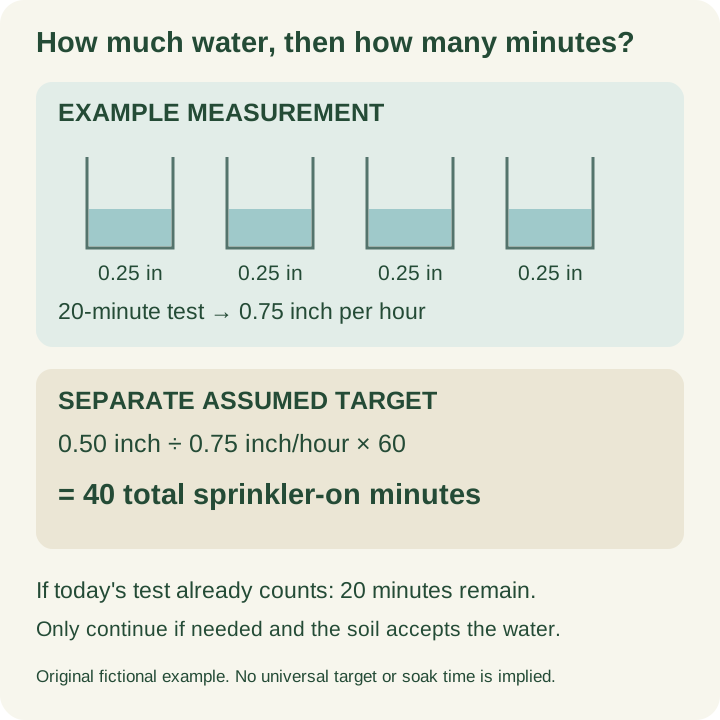
This fictional example uses an assumed irrigation target of 0.50 inch for one watering, already chosen using suitable local guidance and current conditions. It is not a recommended amount for every lawn.
Suppose four containers each collect 0.25 inch during a 20-minute test:
- Average depth: (0.25 + 0.25 + 0.25 + 0.25) divided by 4 = 0.25 inch
- Application rate: 0.25 inch divided by 20 minutes, multiplied by 60 = 0.75 inch per hour
- Total runtime: 0.50 inch divided by 0.75 inch per hour, multiplied by 60 = 40 minutes
Check the result another way: the 0.50-inch target is twice the measured 0.25 inch, so it takes twice the test's 20 minutes.
If the test was the first part of today's watering, those 20 minutes already count. Only 20 additional sprinkler-on minutes remain, provided the target still applies and the soil can accept the water. Equal readings at four sampled spots do not prove perfect coverage everywhere.
This estimate assumes unchanged equipment, pressure, and coverage. It does not measure how much water stayed in the root zone.
Count rain and stop before runoff
Include rainfall when deciding whether irrigation is still needed. Keep a rain gauge, check recent weather, and inspect the soil. A heavy downpour can run off without thoroughly moistening the roots, so a rain total alone cannot show how much usable moisture remains. Maryland Extension describes this distinction.
If water pools or escapes onto a path or street, stop. Let it soak in, then reassess before resuming. EPA WaterSense recommends dividing runtime into shorter cycles with soak breaks, especially on slopes and clay-rich soils.
In the worked example, 40 minutes means total sprinkler-on time. Breaks add to elapsed time. The calculation does not justify running continuously for 40 minutes, nor adding extra minutes to replace water that ran away. Resolve persistent runoff or poor infiltration with local help.
For a separate runoff example, suppose pooling starts after eight sprinkler-on minutes. Stop and let that water soak in. At the next permitted opportunity, test a shorter five-minute cycle while watching the surface. Allow soak periods between cycles, resuming only when the soil can accept more. If pooling returns sooner, shorten the cycle or stop to investigate.
The eight-minute observation and five-minute trial are fictional, not settings to copy. EPA's cycle-and-soak explanation uses observed pooling to guide cycle length. No single soak time fits every site, and persistent runoff is a reason to stop rather than finish the calculated minutes.
Brown grass does not settle the watering question
Dull blue-green color, folded blades, and lingering footprints can be clues to moisture stress. University of Georgia Extension describes these signs. Compare soil moisture and sprinkler coverage before changing the timer.
Dry soil in one area may reflect uneven delivery. CSU recommends comparing catch-can readings in dry and green spots; increasing every zone's runtime can overwater the areas already receiving enough.
Persistently wet soil calls for a different investigation. Overwatering, poor drainage, and compaction can also weaken turf, as Maryland's guide to non-pest lawn problems explains. Water collecting between irrigation cycles may indicate a leak; EPA's inspection checklist helps identify faults.
Record the pattern and how it changes. Seek local extension or qualified irrigation help for spreading damage, persistent wetness, or unexplained patches.
Adjust for the season and local rules
Revisit the schedule when weather or growth changes. A summer setting should not run unchanged through cooler, wetter conditions. Dormancy also changes the goal: get grass-specific local advice rather than trying to restore every brown lawn with longer runs.
When permitted, morning watering is a useful starting point. Maryland Extension recommends morning irrigation to limit prolonged leaf wetness and afternoon evaporation. Check your water provider's current allowed days, hours, and drought restrictions before testing or watering.
Keep a small observation routine
Use the same few locations so comparisons are meaningful:
- Before watering: note rain, soil moisture, grass appearance, and current restrictions.
- While watering: watch coverage, leaks, pooling, and runoff. Record sprinkler-on minutes.
- After water has soaked in: check moisture where roots are growing and note uneven results.
- Before the next planned watering: check again. Change the plan when observations change.
Our lawn-care log guide shows a simple format for that history. Also review the grass-specific mowing guide if cutting height may be adding stress.
You can use this checklist on its own. Keep the measurements in a lawn-care log, alongside rainfall, soil checks and the response you observe after watering.
Build on these observations with another practical lawn-care guide. Continue with How to Keep a Lawn Treatment Log You Can Actually Use.
Keep your watering checks together
Record rainfall, irrigation, soil moisture and the grass response in a lawn-care log so the next watering decision has useful context.
Keep a lawn-care log