
Seeding and aftercare
When Can You Mow After Overseeding? A Readiness Checklist
Measure the seedlings and existing grass separately, check the ground, and choose a locally appropriate cutting height before the first pass.
By Seed & Mow · 8 min read · Sources checked
The right first-mow decision depends on what is growing, its measured height, and whether the lawn can be mowed without disturbing the new growth. A fixed number of days after seeding cannot answer those questions. Measure the seedlings separately from the old grass, choose a cutting height appropriate to your grass and local guidance, and avoid removing more than one-third of the height in one cut.
This guide focuses on cool-season home lawns. Winter ryegrass overseeding of warm-season turf, new sod, and grass started from plugs or sprigs need their own establishment instructions.
Are you mowing old grass, new grass, or both?
Overseeding leaves established plants growing beside new seedlings. The old grass may need attention before the new grass reaches a mowing height.
Iowa State's overseeding guide advises continued mowing to limit competition from the existing turf, then a gradual height increase as seedlings enter the cut. Its low initial settings apply to the cool-season system described there; they are not a national tall-fescue setting.
Before deciding to wait another week, part the canopy and look underneath it. Is the tall growth established grass, new seedlings, or weeds? Are there still emerging seedlings among larger plants? Keep those observations separate. If you cannot identify the species or choose a compatible cutting height for a mixed lawn, ask your local extension service for a mowing plan.
Why published waiting periods differ
University guidance addresses different regions and establishment methods:
- Maryland Extension describes mowing beginning around four to six weeks after seeding under favorable conditions. It also allows an earlier light cut when new grass is just above the chosen mowing height.
- Purdue and Illinois Extension recommend starting when the earliest seedlings are tall enough to cut, even though only part of the stand may be clipped initially. Their guide uses species-specific initial settings.
- UC's new-lawn guidance takes a more conservative approach, including waiting for seed germination and allowing substantial establishment time.
These recommendations should not be averaged into a new universal wait period. Select guidance for your species, location, and planting method. The shared practical questions are what the mower will cut and what conditions it will cross.
The readiness checklist
1. Write down the grass and planting details
Keep the seed label, sowing date, and first observed emergence date. Note whether this was seed into existing turf or a new stand on bare soil. If the bag contains multiple species, record them rather than calling everything “fescue.”
UC's grass-development guide explains that establishment method and seasonal growth affect care. A calendar date is useful history; it is not proof that all plants are at the same stage.
2. Measure several places without pulling seedlings
Place a ruler upright at soil level alongside the grass. Do not measure from the top of a thick layer of leaves or mulch. Record taller and shorter areas separately, including an exposed patch and a shaded area if present. Photograph the ruler position if you want to repeat the measurement.
This is a practical recording method, not a validated sampling protocol. One tall leaf is not representative of the whole lawn. Avoid repeatedly tugging new seedlings to “test” them; a casual tug does not provide a calibrated mowing-readiness threshold.
3. Choose the target height before calculating the cut
Use the local recommendation for your grass and stage. For example, Maryland's new-lawn guidance illustrates tall fescue at 4 inches cut to 3 inches. That example removes 1 inch, or 25% of its starting height, and stays below the one-third limit. It is an example for that context, not a requirement for every species.
If the mower's numbered positions do not state inches, consult its manual. Verify the actual grass height after a careful pass rather than assuming “setting 3” means 3 inches. Follow the manufacturer's safety instructions for adjustments; never reach under a mower that can start.
4. Check the surface and equipment
The leaves should be dry enough to cut cleanly, and the ground should not be soft enough for the mower or your steps to rut or smear it. UC's mowing guidance explains why wet leaves stick to blades and clog equipment. Its lawn weed-management guidance also warns that mowing wet soil can compact it.
Use sharp, properly maintained blades. Maryland's establishment guide warns that dull blades can shred or pull new grass. If the equipment is tearing plants out, stop and reassess. Mower weight, turning, slopes, and access routes matter; a height measurement alone cannot approve a heavy machine on soft ground.
5. Keep the first pass gentle and inspect the result
Check the cut, surface, and clippings before doing the entire area. Avoid tight turns over fragile patches. If clippings pile up, do not leave a dense mat over seedlings. Pause rather than making repeated passes across wet or damaged turf.
Keep watching the shorter plants afterward. In an uneven stand, a successful cut of the tallest growth does not mean that all seedlings are established. Purdue and Illinois's staged-mowing approach is a useful reminder that development is uneven.
Worked example: three heights, two decisions
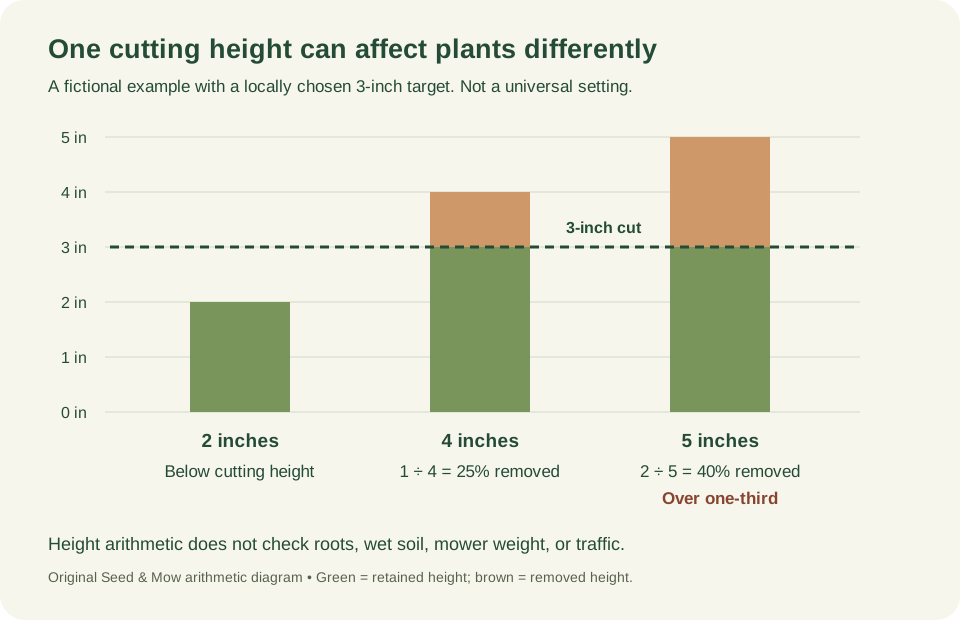
This fictional example illustrates measurement and arithmetic. It does not diagnose a lawn or prescribe a universal 3-inch target.
Suppose locally appropriate guidance has led you to a 3-inch cutting height for a tall-fescue area. You record:
- A seeded patch with plants around 4 inches tall
- A slower patch with seedlings around 2 inches tall
- Established grass around 5 inches tall nearby
At a 3-inch cut, the 4-inch growth loses 1 inch: 1 divided by 4 is 25%. The 2-inch seedlings should remain below that cutting plane, although wheels and foot traffic still cross them. The 5-inch old grass would lose 2 inches: 2 divided by 5 is 40%, which exceeds the one-third limit.
The one-third rule means leaving at least two-thirds of the starting height. For 5-inch grass, that is about 3.33 inches. A suitable higher available setting, followed by reassessment, may be needed instead of cutting straight to 3 inches. The UC one-third guide recommends returning an overgrown lawn to its intended height gradually.
Now add one more observation: the slower patch is soft after rain. The arithmetic still works, but the ground condition can postpone that area. You have two separate decisions: an acceptable amount to remove and whether you can cross the surface safely without damage.
What to do after the first mow
Record the date, actual cut height, which areas were mowed, and any pulling, rutting, or heavy clippings. Use the lawn-care log guide if you want a repeatable format.
Continue checking moisture where the new roots are developing. UC's new-lawn irrigation guide emphasizes even coverage and adjustment during establishment. The first mowing does not automatically switch every seedling to an established lawn's watering routine.
Do not treat the first cut as permission to apply a weed killer or fertilizer. Those decisions need separate evidence, local guidance, and the exact product's current directions. If unfamiliar growth is appearing, the weed-observation guide helps you collect useful identification details.
Quick questions
Is two weeks always too soon?
No universal day count settles it. Check your grass, its actual growth, and the applicable local establishment guidance. Two lawns seeded on the same day can be at different stages.
Should I wait until every seedling is the same height?
Uniform growth is unlikely, especially in mixtures. Guidance differs on when to start, so use the approach appropriate to your situation. Meanwhile, keep track of established grass that may be shading new growth.
Can I use the highest mower setting?
Only if its actual cutting height fits the lawn and the amount being removed. “Highest” is an equipment position, not a species-specific recommendation or a guarantee that the ground will support the mower.
Your take-outside checklist
- Grass species or mixture: known / uncertain
- Seeding and emergence dates recorded
- New seedlings measured separately from old grass
- Local guidance and target cutting height recorded
- No more than one-third removed from the growth being cut
- Leaves reasonably dry; surface firm enough for equipment
- Mower maintained and actual setting understood
- Fragile areas, turns, and access route considered
- First-pass result checked; stop if pulling or rutting occurs
- Moisture and next observation recorded afterward
You can copy or print this checklist without signing up. Keep the measurements and conditions in a lawn-care log so you can compare the next inspection. A record does not certify that a first mow is safe.
Build on these observations with another practical lawn-care guide. Continue with How to Mow Your Lawn for the Grass You Actually Have.
Keep the grass type in the mowing decision
Once the new lawn is ready for mowing, use the grass-type mowing guide to check the locally suitable height, mower setting and cut quality.
Read the grass-type mowing guide