
Grass types
Does Tall Fescue Spread? What to Do About Bare Spots
Tall fescue can thicken around existing plants, but an empty patch needs a closer look. Learn what to observe before deciding to wait or repair.
By Seed & Mow · 7 min read · Sources checked
Tall fescue can grow thicker around an existing plant, but it has limited ability to move sideways into bare ground. If a patch has lost its grass plants, waiting for surrounding tall fescue to creep across it is usually a poor repair plan. The University of California's tall-fescue guide describes its bunch-type growth and notes that open areas may need reseeding.
The useful next question is whether you have thin, living turf or a genuinely bare patch. Those situations call for different decisions.
What “spreading” means in a lawn
Three processes can make a lawn look fuller:
- Tillering: new shoots develop close to the base, or crown, of an existing plant. A clump becomes denser.
- Rhizomes: underground stems extend away from a plant and can produce new shoots elsewhere.
- Stolons: stems run along the surface and can produce new shoots at their nodes.
Oregon State's explanation of grass growth separates these structures. More leaves leaning over a gap do not establish that new plants have rooted in its center. When checking progress, look for shoots emerging from the soil, rather than judging coverage from above.
Tall fescue is primarily bunch-forming, although short rhizomes can occur. Rutgers' tall-fescue guide explains both its short-rhizome potential and its limited lateral spread. The source concerns New Jersey sports fields; its growth description is useful here, but its seed mixtures and maintenance rates are not a home-lawn prescription. That qualification matters: “never spreads at all” is too absolute, while “will repair its own bare spots” promises too much. A claim about a particular cultivar needs evidence for that cultivar and growing conditions.
Does all fescue behave the same way?
No. Tall fescue and the fine fescues are different grasses. The fine-fescue group includes strong and slender creeping red fescue, Chewings fescue, hard fescue, and sheep fescue. Minnesota Extension's seed guide identifies the group and explains how to read a seed label.
Creeping red fescue produces rhizomes, while sheep fescue is bunch-forming, as NC State's fine-fescue guide explains. Illinois Extension's comparison also distinguishes tall fescue from the fine-fescue group. Do not assume that a bag described simply as “fescue” tells you how the finished lawn will recover from damage.
Check the species and cultivar names on your seed record. A mixed lawn may also contain a spreading grass such as Kentucky bluegrass. Visible recovery in that mixture cannot automatically be credited to tall fescue.
First, decide what is actually missing
Part the leaves gently and inspect a few representative spots. Record which description fits:
- Living plants remain throughout the area. It looks open between clumps, but new shoots are present. Track density as the grass grows and check whether your care fits the species.
- There is a distinct area of exposed soil or dead, matted material. Plan a patch repair after identifying why the grass was lost.
- Plants are brown, and you cannot tell whether they are alive. Do not diagnose death from color alone. Record weather and watering history and get local advice if the answer is unclear.
- The same area fails repeatedly. Investigate the site before buying more seed.
These are observation categories, not a test that diagnoses a disease. Maryland Extension's lawn-repair guide recommends addressing causes such as compaction and poor drainage before filling declining areas. Record shade, traffic, standing water, recent work, and how the problem changes over time.
Make a repair plan that addresses the cause
For a confirmed bare patch, reseeding or matching sod can replace missing plants. Maryland's repair guidance calls for removing matted dead material so seed or sod can contact the soil. Whole-lawn renovation is a separate decision; one damaged corner does not automatically justify starting over.
Before seeding:
- Check that the grass you intend to grow fits the site's light and conditions.
- Keep heavy use away from the repair area while it establishes.
- Choose locally suitable seed and use its directions for the actual repair area. Do not assume that doubling the seed gives twice the result.
- Check previous product records for any restrictions on reseeding. If you do not know what was applied, find out before sowing.
- Use a soil test for nutrient or pH decisions. A thin lawn alone does not establish that it needs fertilizer or lime.
The soil-testing guide can help you prepare useful questions for a lab. If unfamiliar plants are occupying the gap, use the weed-observation guide before choosing a treatment.
Choose timing for your region
Tall fescue is a cool-season grass, but there is no single nationwide reseeding date. In North Carolina, NC State's maintenance calendar distinguishes western-region late-summer renovation from later timing in the Piedmont and coastal plain. It also cautions that severely damaged tall fescue often needs reseeding.
Farther north, winter survival changes the decision. The Minnesota seed guide notes that spring-planted tall fescue can survive its first winter better and warns against sites that hold winter ice. Use your local extension's guidance rather than transferring a southern fall date to a northern lawn.
Once seed is down, establishment care matters more than a promise of rapid spread. Keep notes on emergence, moisture, and mowing. The grass-type mowing guide explains how to choose an appropriate routine for established turf; new seedlings need their own aftercare plan.
Worked example: an open patch beside a path
This is a fictional observation example, not a customer case or recovery forecast.
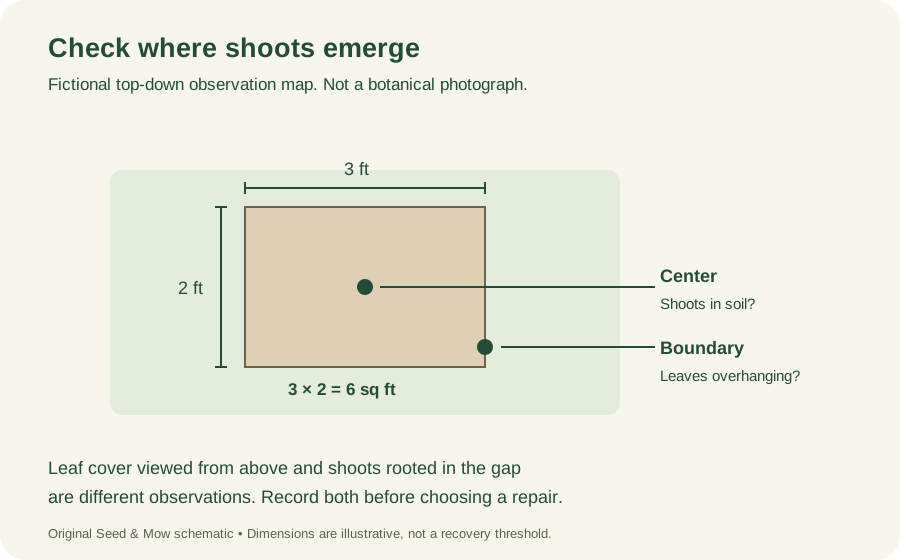
Imagine a tall-fescue lawn with a roughly rectangular gap measuring 2 feet by 3 feet. Its approximate area is 6 square feet. The leaves at the edge bend over the gap, but the center contains no visible grass shoots emerging from the soil.
Write down two separate facts:
- “Leaves cover part of the gap when viewed from above.”
- “No shoots observed in the center at soil level.”
Take an overview and a close-up from the same position on later checks. Label the area and date. If people regularly cut across that corner, include that observation in the repair plan. Adding seed without addressing continued wear leaves an important question unresolved.
Your next step is to investigate the site and choose locally timed patch repair. You do not need to calculate how many inches the surrounding fescue should spread each week; the sources do not establish a dependable rate for that purpose.
Common questions
Will tall fescue get thicker without overseeding?
Surviving plants can produce more shoots. That can improve density where plants remain, but it does not guarantee that an empty patch will acquire new plants. Compare soil-level observations over time.
Can extra fertilizer make it spread faster?
Fertilizer does not change a grass's basic growth habit. Make nutrient decisions from local guidance and soil-test information, not a target “spread rate.” Avoid using repeated feeding as a substitute for investigating a failing area.
Should I add Kentucky bluegrass to make the lawn repair itself?
A spreading species changes the mixture and its management needs. Choose a mixture for climate, shade, water, traffic, and appearance together. A single desirable trait is not enough to select seed for a particular lawn.
Keep the next step small
Start by naming the affected area, recording whether plants remain, and noting the likely pressures on it. The lawn-care log guide provides a simple record format.
If the grass itself is uncertain, use the grass identification guide to compare visible clues before applying species-specific advice. Identifying the grass does not confirm the cause of a bare patch or replace local advice.
Build on these observations with another practical lawn-care guide. Continue with Test Your Lawn Soil Before Buying Amendments.
Start by checking the grass
Compare visible grass features before applying species-specific advice. A possible identification does not establish the cause of a bare patch.
Explore grass identification