
Weed identification
Dallisgrass vs. Crabgrass: Check These Clues First
Compare growth, leaf bases and seedheads, then record what is still uncertain. A recently mowed clump needs more than a color or a guess.
By Seed & Mow · 7 min read · Sources checked
Dallisgrass is a perennial that can persist through short underground stems. The crabgrasses commonly found in lawns are usually summer annuals that return from seed. That difference matters, but a coarse clump, a pale leaf or a plant returning in the same corner cannot identify the weed on its own. The University of California's weed FAQ explains why these lookalikes need different management approaches.
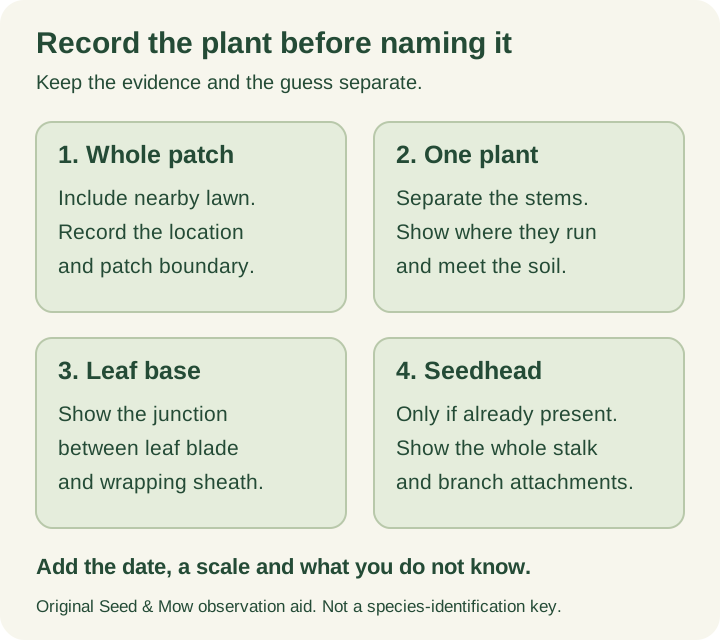
Start with one plant. Compare its growth at soil level, leaf bases and any intact seedhead. If mowing has removed the flowers, use several vegetative traits or ask your local extension service to help. You do not need to buy a treatment to make useful progress today.
Compare the whole plant before one leaf
Clues that fit dallisgrass
- A persistent bunch or clump, sometimes with a thinning center as it ages
- Short, thick underground stems with a ringed appearance
- Flowering branches attached at different points along a stalk, often drooping
The UC dallisgrass guide describes the expanding clump and distinctive short rhizomes. A rhizome is a stem below the soil, rather than a fine root. You may see one when a sample is carefully lifted, but a young plant may not yet show that feature clearly.
Clues that fit crabgrass
- Branching lower stems that spread across the ground
- Roots developing at stem joints where they touch soil
- Slender, fingerlike flowering branches toward the end of a stalk
Maryland Extension's crabgrass profile describes this spreading habit and shows a recently mowed plant. Crabgrass can also grow upward and several plants can merge into a clump. “Upright means dallisgrass” and “flat means crabgrass” are shortcuts that can mislead you.
Treat these as clues to compare, not a three-item test that guarantees a name. Check several plants separately if the patch looks mixed.
Use a seedhead when one is already present
Trace the flowering branches back to the main stalk. Notice where they attach, how they hang and the shape of the small seed-bearing structures. Photograph the entire head and a close view against a plain background.
UC's dallisgrass identification gallery describes drooping branches arising at different points. NC State's weed-identification guide describes hairy spikelets arranged along the branches. Its pasture context does not make its treatment practices a home-lawn prescription; here it is useful for plant structures and reference photographs.
Crabgrass also has branched, fingerlike heads. Their appearance overlaps with other grasses, and branch counts vary. Avoid identifying a plant from “it has five fingers” or dark spots alone. Instead, compare the whole attachment pattern and the plant below it with the primary-source photographs linked here.
If no head is present, take the next route. There is no need to let an uncertain weed shed seed just to obtain a picture.
No seedhead? Inspect the leaf base and stems
A recently mowed lawn hides useful features. The UC lawn weed key was designed around vegetative traits for precisely that reason. It covers common California lawn weeds, so it is a helpful starting point rather than a complete inventory for every region.
Gently separate one blade from surrounding leaves and look where it joins the sheath that wraps the stem. A small membrane in this region is called a ligule. Photograph the junction close enough to see it, without tearing the specimen apart first.
The University of Kentucky's grass-identification guide shows why one feature is insufficient: dallisgrass and crabgrass can both have a conspicuous membranous ligule and rolled young leaves. Those observations can help someone work through a key, but they do not settle this pair by themselves.
Hairiness also needs context. Large, or hairy, crabgrass and smooth crabgrass are different species. Minnesota Extension's crabgrass guide describes that distinction. A smooth-looking leaf does not rule out crabgrass, and a few hairs do not automatically confirm it.
Record:
- Whether the stems run across the surface and root at joints
- Whether a lifted sample has short underground stems
- The leaf-blade and sheath hairs you can actually see
- A close-up of the leaf-to-sheath junction
- Which details remain missing or unclear
Stop there if identification is still uncertain. Repeatedly pulling at an unidentified patch can damage the lawn you want to keep.
Check the calendar without turning it into a verdict
A clump returning after winter can support a perennial-grass hypothesis. It does not prove dallisgrass. New crabgrass seedlings may appear in the same favorable location, and the UC crabgrass guide notes that plants sometimes survive where there is no killing frost.
The useful record is more specific than “it came back”: did you observe the same crown remaining through the season, or did new seedlings appear? Date-stamped photos of the same spot help you distinguish those observations. If you have no winter record, write “unknown.”
A failed treatment is also history, not a plant-identification test. Record what happened rather than deciding that a weed must be dallisgrass because a product did not remove it.
Leave room for a third possibility
Two names in a search query do not mean your plant must be one of them. Goosegrass can have a flattened, pale or silvery center; Kentucky's identification guide describes its shorter ligule and folded young leaves. UC also lists knotgrass and tall fescue among dallisgrass lookalikes. A desirable lawn grass can look out of place when its variety, growth or surroundings differ.
Keep an example of the grass you want to keep in a separate photograph. The general weed-observation guide helps organize that comparison. If a planting record says tall fescue, the tall-fescue growth guide explains its bunching habit; it cannot identify an unknown clump for you.
Choose a small next step after identification
For a small, confirmed crabgrass infestation, Maryland describes hand removal of young plants as an option. With confirmed dallisgrass, UC recommends removing young plants before rhizomes and seed develop; mature plants can return if underground stems remain. Ask for local help if a large patch, buried irrigation equipment or uncertain desirable grass makes removal difficult. Do not use pulling difficulty as an identification test.
Record the area you cleared and check for new growth later. Choose repair timing and grass appropriate to your region rather than leaving a persistent bare spot. Use the mowing guide to check the lawn's normal cutting height instead of scalping the whole area to chase one weed.
This comparison does not select an herbicide. If treatment is considered later, the exact weed, desirable turf, site and current product directions all matter. The EPA's label guidance explains why the actual label must guide use. A photograph or an article title cannot establish those conditions.
A useful identification request
Here is a fictional note you can adapt:
“Coarse grass in the side lawn, noticed October 8. The lawn was mowed yesterday, so no intact seedhead is visible. Some stems run along the ground. I have not checked for underground stems. I do not know whether the same crown survived last winter. Attached are a whole-patch view, one separated plant, its leaf base and a ruler for scale.”
That note preserves uncertainty and gives an extension office a clearer starting point than “please confirm this is crabgrass.” Ask what sample or extra view is needed before collecting or mailing anything.
Keep the eventual identification, action and follow-up observation in your lawn-care log. The weed identification guide offers more features to compare; use a local identification service when the match remains uncertain.
Build on these observations with another practical lawn-care guide. Continue with How to Identify Lawn Weeds Before Choosing a Treatment.
Check one more identifying feature
Compare the whole plant, leaves and seedheads before deciding what is growing. Keep uncertain features open and confirm the match before treatment.
Explore weed identification